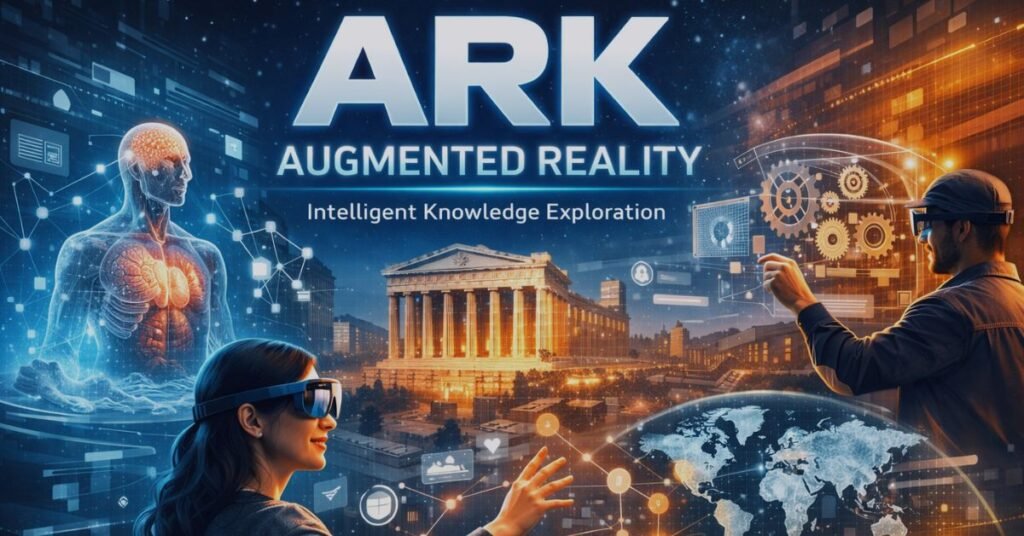
Augmented reality (AR) is evolving rapidly, and ARK Augmented Reality is gaining attention as a concept that blends knowledge systems, artificial intelligence, and immersive AR experiences. Instead of simply overlaying digital objects onto the real world, ARK focuses on interactive knowledge-driven environments that can understand context and respond intelligently.
In simple terms, ARK Augmented Reality combines AR technology with knowledge systems so digital content can adapt, interact, and evolve based on user input and real-world data.
As AI-powered search engines and emerging technologies continue to reshape digital experiences, ARK represents a shift toward smarter, more context-aware augmented reality systems.
Why ARK Augmented Reality Matters Today
The modern tech landscape is moving toward intelligent, context-aware interfaces. Traditional AR applications display digital layers over reality, but they often lack deeper understanding.
ARK Augmented Reality is important because it aims to create AR systems that can:
- Understand knowledge relationships
- Adapt to user interaction
- Generate emergent experiences
- Connect AI reasoning with spatial computing
This matters in industries like:
- Education
- Healthcare
- Engineering
- Training simulations
- Interactive learning environments
As AR hardware improves and AI becomes more powerful, systems like ARK could help transform how humans interact with digital knowledge in physical spaces.
What Is ARK Augmented Reality?
ARK Augmented Reality is a conceptual framework for building AR environments that integrate knowledge structures with interactive spatial computing.
Instead of showing static AR objects, ARK systems aim to:
- Organize information as knowledge networks
- Present that knowledge in 3D augmented environments
- Allow users to interact with and explore the information dynamically
The Key Idea
ARK treats knowledge like a living system inside augmented reality.
For example:
- A medical student could explore a 3D human anatomy model where every organ connects to deeper layers of medical knowledge.
- An engineer could visualize a machine and see interactive explanations of each component in real time.
This approach turns AR into a knowledge exploration platform, not just a visualization tool.
Core Concepts Behind ARK Augmented Reality
Understanding ARK requires looking at the core technologies and ideas that support it.
1. Knowledge Graph Integration
ARK systems rely heavily on structured knowledge networks.
These knowledge graphs connect concepts, data, and relationships so AR environments can display meaningful information.
Example:
A historical monument could display:
- timeline events
- related figures
- architectural details
- interactive educational content
All connected through a knowledge graph inside the AR system.
2. Interactive Exploration
ARK environments are designed for active discovery rather than passive viewing.
Users can:
- select objects
- explore layers of information
- trigger new visualizations
- navigate through knowledge structures
This creates a learning-by-exploration experience.
3. Emergent Abilities
One of the most interesting aspects of ARK is emergent behavior.
Emergent ability means the system can generate new insights or interactions that were not explicitly programmed.
This happens when:
- AI models process user actions
- knowledge systems connect related information
- AR environments dynamically respond
The result is a more intelligent and adaptive AR experience.
How ARK Augmented Reality Works
While ARK is still an evolving concept, the framework typically combines several technologies.
Key Components
- Augmented Reality Hardware
- AR glasses
- mobile AR apps
- spatial computing devices
- AI and Machine Learning
- natural language processing
- pattern recognition
- adaptive learning systems
- Knowledge Databases
- structured knowledge graphs
- semantic data systems
- Interactive Interfaces
- gesture interaction
- voice commands
- spatial navigation
Together, these components allow AR systems to interpret information and present it intelligently within physical environments.
Real-World Applications of ARK Augmented Reality
Although still emerging, ARK-style systems have many potential applications.
Education and Learning
ARK could transform education by turning learning into interactive exploration.
Examples include:
- visualizing historical events in real locations
- exploring scientific concepts in 3D
- interactive knowledge maps for complex topics
Students would no longer just read information—they would experience it spatially.
Healthcare Training
Medical training could benefit greatly from ARK-based systems.
Possible use cases:
- 3D anatomy exploration
- surgical training simulations
- contextual medical knowledge overlays
This allows medical professionals to learn through immersive interaction.
Engineering and Manufacturing
In technical industries, ARK could provide real-time knowledge assistance.
For example:
- AR overlays explaining machine parts
- troubleshooting guides attached to equipment
- interactive repair instructions
Workers could access complex technical knowledge instantly.
Cultural Heritage and Museums
Museums and historical sites could become far more engaging.
Visitors might:
- explore artifacts with interactive historical context
- see reconstructions of ancient structures
- navigate knowledge timelines
This creates immersive storytelling experiences.
ARK vs Traditional Augmented Reality
Understanding the difference helps clarify why ARK is gaining attention.
| Feature | Traditional AR | ARK Augmented Reality |
|---|---|---|
| Content | Static overlays | Knowledge-driven content |
| Interaction | Limited | Deep exploration |
| Intelligence | Minimal | AI-supported reasoning |
| Structure | Visual layers | Knowledge networks |
| Experience | Passive viewing | Interactive learning |
ARK represents a shift from visual AR to intelligent AR systems.
Why ARK Augmented Reality Is Gaining Attention
Several trends are driving interest in ARK concepts.
1. Advances in AI
Modern AI models can process language, images, and context, making knowledge-driven AR possible.
2. Growth of Spatial Computing
Devices like AR headsets and mixed reality platforms are becoming more powerful.
3. Demand for Interactive Learning
Industries increasingly want tools that teach through exploration instead of static content.
4. Knowledge Graph Technologies
Structured data systems allow AR environments to organize information meaningfully.
Together, these trends make ARK a promising direction for future augmented reality platforms.
Practical Example of an ARK Experience
Imagine visiting a historical city with AR glasses.
You look at an old building and see:
- a 3D reconstruction of the original structure
- information about the architects and historical period
- connections to related historical events
You can tap or gesture to explore deeper layers of knowledge.
Instead of reading a plaque, you experience a dynamic knowledge environment.
Challenges of ARK Augmented Reality
Despite its potential, ARK faces several challenges.
Technical Complexity
Building knowledge-driven AR systems requires advanced infrastructure.
Data Organization
Knowledge graphs must be accurate and well-structured.
Hardware Limitations
AR devices are still evolving.
Content Creation
Creating interactive knowledge environments requires significant effort.
However, these challenges are gradually being solved as AR and AI technologies improve.
The Future of ARK Augmented Reality
The future of ARK lies in the convergence of:
- artificial intelligence
- spatial computing
- semantic knowledge systems
- immersive interaction design
As these technologies mature, ARK-style systems could become the next generation of knowledge interfaces.
Instead of searching for information on screens, people may explore knowledge directly within their physical environment.
Conclusion
ARK Augmented Reality represents a new approach to augmented reality that combines AI, knowledge systems, and spatial interaction.
Unlike traditional AR, which mainly overlays visuals, ARK aims to create intelligent knowledge environments that users can explore interactively.
While still an emerging concept, its potential impact spans education, healthcare, engineering, and cultural experiences.
As AI and spatial computing continue to advance, ARK could play a major role in shaping how humans interact with information in the real world.