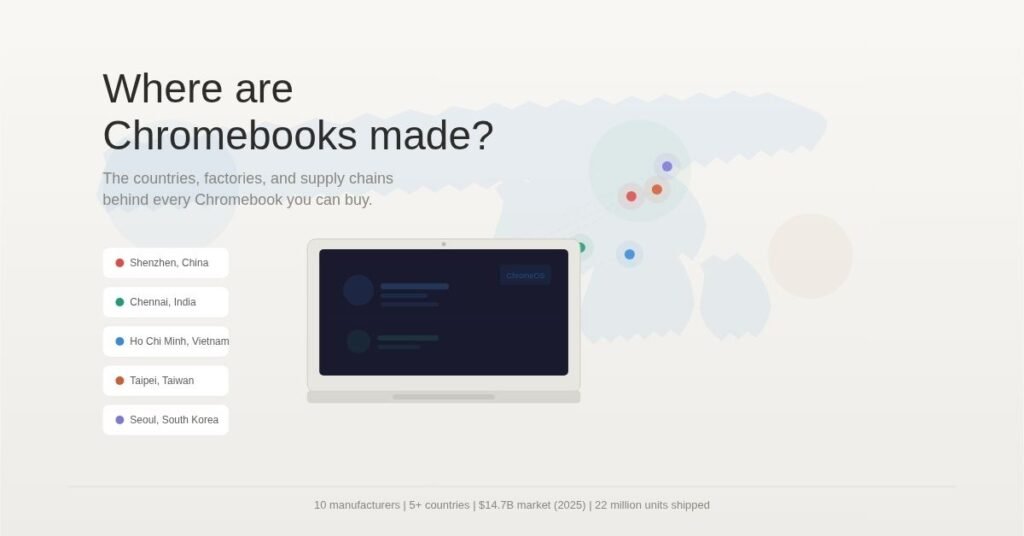
You’ve probably typed on a Chromebook at school, at work, or on your couch. Maybe you’re thinking about buying one. But here’s a question most people skip over: where does this thing actually come from?
If you’re a tech enthusiast or an engineer who cares about supply chains, this matters. If you’re someone who wants to know what you’re spending money on, it matters even more. The short answer? Chromebooks aren’t built in one place. They’re a global effort, spread across factories in China, India, Vietnam, Taiwan, and South Korea.
Let’s break it all down.
Who Makes Chromebooks?
Google designs the Chrome OS software but doesn’t build most Chromebook hardware itself. Instead, it licenses Chrome OS to manufacturers like Lenovo, HP, Acer, ASUS, Samsung, Dell, and others. As of 2025, 10 active manufacturers sell Chromebooks globally.
Think of it like this: Google writes the recipe, and companies like HP and Lenovo do the cooking. Each brand designs its own hardware, picks its own parts, and assembles the final product in its own factories (or through contract manufacturers).
Some manufacturers, like Fujitsu, NEC, and Sharp, only sell Chromebooks in their home countries (Japan, in their case). LG sells exclusively in South Korea. So the brand you see on the shelf depends a lot on where you live.
Where Are Chromebooks Manufactured?
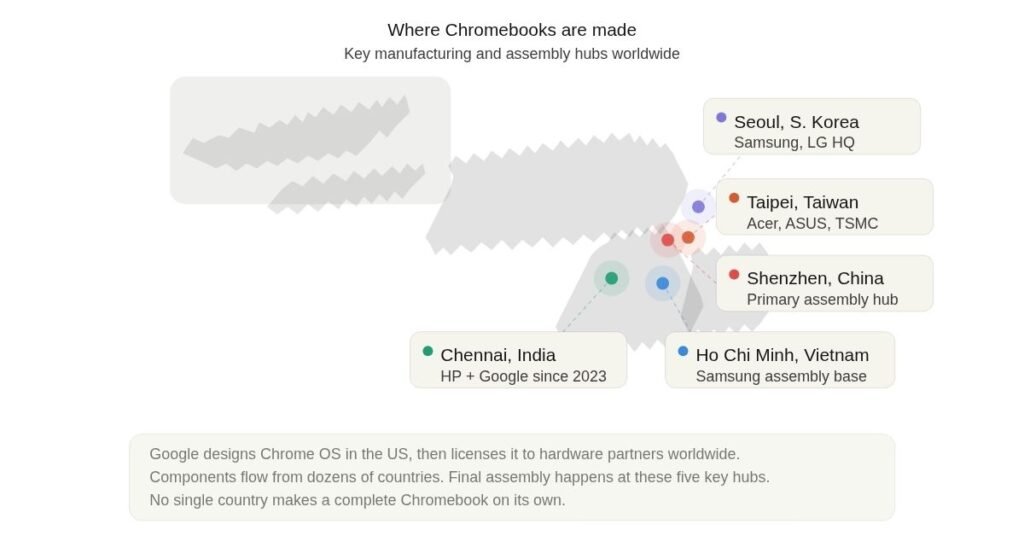
Most Chromebooks are assembled in China, specifically in the Guangdong province and Shenzhen area. Production has also expanded to India, where HP manufactures Chromebooks at a Flex Ltd. facility near Chennai. Vietnam is a growing hub too, with Samsung assembling models there.
China remains the heavyweight. Shenzhen is home to a massive electronics ecosystem. Component suppliers for motherboards, displays, batteries, and casings all sit within a tight radius. That proximity keeps costs low and production fast.
India entered the picture in October 2023. Google partnered with HP to produce Chromebooks locally at a factory near Chennai. This was partly driven by India’s Production-Linked Incentive (PLI) scheme, which offers financial rewards to companies that manufacture tech products domestically.
Vietnam is the quiet contender. Samsung has been assembling laptops and panel modules there for years. The Galaxy Chromebook Go was one of the first Chromebook models built in Vietnam, targeting local markets with budget-friendly specs.
Chromebook manufacturing by country
Where the world’s Chromebooks are designed, built, and shipped
Shenzhen and Guangdong province house the bulk of Chromebook assembly. Component suppliers for motherboards, displays, batteries, and casings sit within a tight radius, keeping costs low and turnaround fast.
HP began Chromebook production at its Flex Ltd. facility near Chennai in October 2023 through a Google partnership. India’s PLI scheme (up to 5% incentive on incremental sales) is pulling more brands into local manufacturing.
Samsung assembles laptops and panel modules in Vietnam. The Galaxy Chromebook Go was one of the first models built there. Low labour costs and EU tariff preferences make it attractive for mid-range production.
Acer and ASUS are both headquartered here. TSMC fabricates many of the processors that go inside Chromebooks. Taiwan designs the hardware; factories elsewhere assemble it.
Samsung and LG are both headquartered here. Samsung Display and LG Display produce many of the panels used in Chromebooks worldwide. Samsung also designs its own Exynos processors.
Production share estimates are approximate, based on industry reporting from TrendForce, TechHQ, and Accio supplier data. Taiwan and South Korea primarily contribute engineering, design, and components rather than final device assembly. Percentages reflect share of finished Chromebook assembly, not component manufacturing.
- Google partnered with HP to produce Chromebooks locally. Sundar Pichai (Alphabet CEO) announced the partnership on X (formerly Twitter).
- HP has operated the Flex Ltd. factory near Chennai since 2020 for laptops and desktops. Chromebook production was added as a new line in October 2023.
- Dell and HP participate directly in India’s PLI programme. Lenovo, Acer, ASUS, and Thomson participate through EMS partners like Flextronics and Rising Star.
- PLI 2.0 lets applicants choose 2023, 2024, or 2025 as their base year for starting production, giving manufacturers flexibility on timing.
- Chromebooks are priced at the lower end of the market with thin margins, making local production a smart move to avoid potential import restrictions.
Does Google Make Its Own Chromebooks?
Google created the very first Chromebook prototype, the Cr-48, back in 2010. It was built by Inventec, a Taiwanese manufacturer. Since then, Google has released its own Pixelbook line and the Pixel Slate. But today, Google focuses mostly on the software side and lets partners handle hardware.
The Cr-48 was a plain, all-black laptop with no branding. Google handed them out to testers as part of a pilot programme. It was never sold to the public.
Google’s Pixelbook line showed what a premium Chromebook could look like. But Google has mostly stepped back from making its own laptops. The real money is in Chrome OS licensing and the Google services ecosystem that runs on every Chromebook.
What Components Go Into a Chromebook?
A typical Chromebook contains a processor (from Intel, AMD, MediaTek, or Qualcomm), RAM, flash storage, a display panel, a battery, a keyboard, and a plastic or aluminium chassis. Most of these components are sourced from factories across Asia, primarily in China, Taiwan, South Korea, and Japan.
The processor is the brain. Intel and AMD chips are designed in the US but manufactured in facilities across Asia. MediaTek is based in Taiwan. Qualcomm is in San Diego but fabricates chips through partners like TSMC in Taiwan and Samsung in South Korea.
Display panels often come from LG Display or Samsung Display (South Korea), BOE or Innolux (China and Taiwan). Batteries are typically sourced from Chinese suppliers. The final assembly pulls all these pieces together in one factory.
It’s like building a house. The bricks come from one place, the wiring from another, and the plumbing from somewhere else. The builder just puts it all together under one roof.
and storage
and keyboard
assembly
This represents a typical Chromebook supply chain. Exact suppliers vary by brand and model. Colour-coded dots indicate primary country of origin: red = China, blue = US, orange = Taiwan, purple = South Korea, green = India. Sources: TrendForce, Accio, Wikipedia Chromebook page.
How Big Is the Chromebook Market?
The global Chromebook market was valued at roughly $14.7 billion in 2025 and is projected to grow to around $42.85 billion by 2034. About 22 million units shipped globally in 2025. Education drives the bulk of sales, with Chromebooks holding over 60% of the global education device market.
In the US alone, 93% of school districts planned to buy Chromebooks in 2025. That’s up from 84% just two years earlier. Schools love them because they’re affordable, easy to manage, and tough enough to survive a backpack.
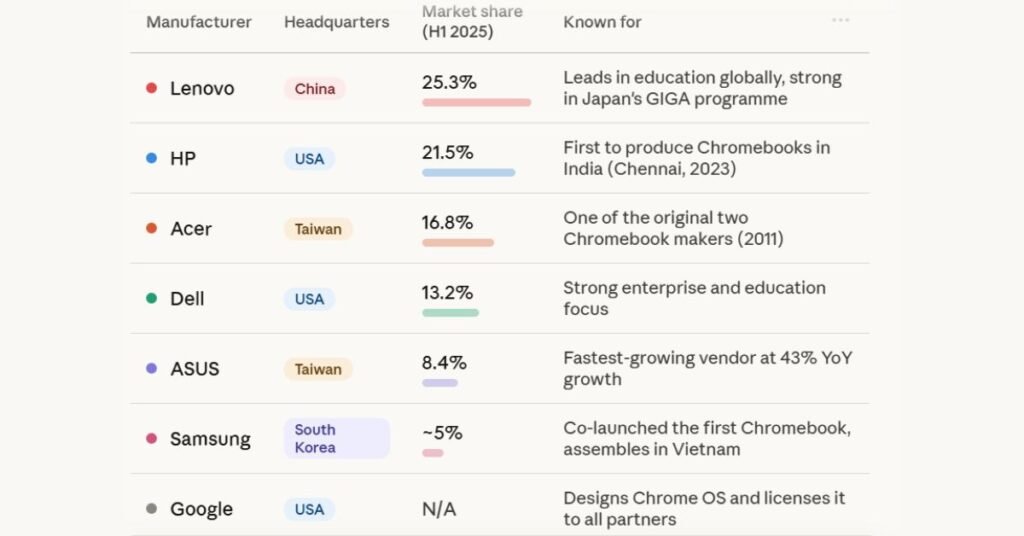
Lenovo leads the pack with 25.3% of the market. HP sits in second place. ASUS is the fastest-growing brand, with 43% year-over-year growth, though from a smaller base.
North America accounts for over 52% of global Chromebook sales. Asia-Pacific is the fastest-growing region, fuelled by government education programmes in countries like Japan, India, and Brazil.
Sources: Mordor Intelligence, Grand View Research, IDC Worldwide Quarterly Chromebook Tracker, Custom Market Insights.
H1 2025 unit shipments worldwide
Source: IDC Worldwide Quarterly Chromebook Tracker (H1 2025)
Can You Avoid Chinese-Made Chromebooks?
It’s very difficult to buy a Chromebook with zero Chinese-made parts. Even if the final assembly happens in India or Vietnam, many core components like batteries, display panels, and circuit boards are still sourced from Chinese suppliers. Some brands like Samsung and LG are South Korean, but their supply chains still rely heavily on Chinese parts.
If country of origin matters to you, check the label on the bottom of the device or the product listing online. Some retailers list the country of assembly.
Taiwan plays a huge role in the Chromebook world. Acer and ASUS are both Taiwanese companies. TSMC, the world’s largest chip foundry, is based in Taiwan. So even if a Chromebook says “Assembled in China,” key components may have been designed or fabricated in Taiwan, South Korea, Japan, or the US.
The reality? Modern electronics are like a potluck dinner. Everyone brings a dish. No single country makes the whole meal.
What’s Coming Next for Chromebook Manufacturing?
Google and its partners are spreading production beyond China. India’s manufacturing push, Vietnam’s growing factory base, and Google’s own “Aluminium” project (merging Chrome OS with the Android kernel) are all shaping where and how Chromebooks will be built in the near future.
India’s PLI scheme is pulling more brands into local production. Dell, Lenovo, Acer, and ASUS are all participating through manufacturing partners already based in India.
On the hardware side, new processors from MediaTek (the Kompanio Ultra) and Qualcomm (Snapdragon X Plus) are pushing Chromebooks into premium territory. Lenovo is building flagship tablets and laptops for Google’s Aluminium project, with high-end specs that rival iPad Pro territory.
The bottom line: Chromebooks are no longer just cheap school laptops. They’re going upmarket, and the factories making them are spreading across more countries.
Key milestones in Chromebook manufacturing
From prototype to a $14.7 billion global market
Sources: Wikipedia, Google Blog, TrendForce, TechHQ, IDC Chromebook Tracker, Chrome Unboxed.
The Bottom Line
Chromebooks are a global product. Google designs the software in the US. Companies in Taiwan, South Korea, China, the US, and Japan design the hardware. Factories in China, India, and Vietnam put it all together. And suppliers from dozens of countries provide individual parts.
There’s no single answer to “where are Chromebooks made?” because no single country owns the process. What you hold in your hands is the result of a worldwide supply chain working in sync.
If you’re shopping for a Chromebook, focus less on where it was assembled and more on whether it fits your needs. Check the specs, read real reviews, and pick the one that works for your budget and workflow.
You Might Also Enjoy:
ARK Augmented Reality: What It Is and Why It Matters
What Is content://cz.mobilesoft.appblock.fileprovider/cache/blank.html? (And How to Remove It)
GPTGirlfriend: Redefining Digital Companionship In The Age Of AI