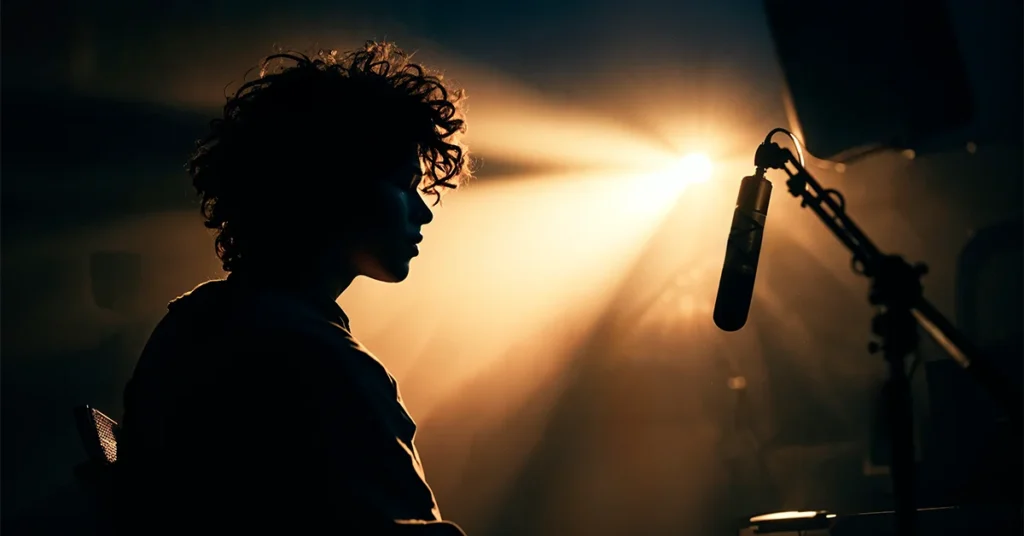
Ever felt like your words are stuck in your throat, desperate to come out but tangled in doubt? You’re not alone. In a world of endless scrolling and quick takes, slam poetry cuts through the noise. It’s raw, real, and refuses to whisper when it can shout, cry, or laugh out loud.
Finding your voice isn’t about having the perfect metaphor or the slickest rhyme. It’s about telling your truth in a way only you can. Whether you’re stepping up to your first open mic or just writing in a notebook at 2 a.m., slam poetry gives you permission to be loud, messy, and completely human.
we’ll break down what slam poetry actually is, how to find your voice within it, and share a full slam poetry sample to spark inspiration. You’ll walk away with practical tips, writing prompts, and the confidence to take the mic—even if that mic is just your phone’s voice recorder for now.
ALSO READ: What Is An Ohio Concept? Breaking Down The Viral Trend
What You’ll Learn Here
- What slam poetry is and how it’s different from page poetry
- How to uncover your unique voice as a poet
- A complete slam poetry sample you can learn from
- Step-by-step techniques to write and perform your own piece
- Common mistakes to avoid and how to push past writer’s block
What Is Slam Poetry Really?
Slam poetry is performance poetry. It was born in the 1980s in Chicago, started by construction worker and poet Marc Smith who wanted to make poetry events feel less like lectures and more like rock shows. The idea: poets perform original work in front of a live audience and judges, usually with a 3-minute time limit, no props, no costumes, no music. Just you, the mic, and your words.
But slam is bigger than the competition rules. At its core, slam poetry is about connection. It’s poetry written for the ear and the heart, not just the page. It leans into rhythm, repetition, breath, and emotion. It can be angry, funny, tender, or all three in one piece.
How slam poetry differs from traditional poetry:
- Performance first: Slam is meant to be heard, not just read. Your tone, pacing, and body language are part of the poem.
- Audience energy: Slams are interactive. Snap, clap, shout— the crowd talks back.
- Accessibility: You don’t need an MFA. You need a story and the guts to tell it.
- Time constraint: Most slams cap poems at 3 minutes with a 10-second grace period. It forces clarity and impact.
If traditional poetry is a painting in a quiet gallery, slam poetry is graffiti on a city wall. Both are art. One just refuses to be ignored.
Why Finding Your Voice Is The Heart Of Slam
Finding your voice sounds like advice from a motivational poster. But in slam, it’s practical. Your voice is the mix of your experiences, your rhythm, your obsessions, and the way you see the world. No one else has lived your life. That’s your advantage.
A lot of new poets think they need to sound like someone else to be taken seriously. They mimic the poets they admire. That’s normal at first. But the poets who make you feel something? They stopped imitating and started excavating their own stories.
Signs you’re writing in your voice:
You get a little nervous sharing it. If it feels too honest, you’re probably close.
You hear your natural speaking cadence in the lines.
You write about the thing you can’t stop thinking about at midnight.
You’re not trying to impress, you’re trying to express.
Slam poet Sarah Kay said, If you make something, chances are somebody is going to hate it. Just be sure that somebody isn’t you. Finding your voice means writing the poem only you can defend at 3 a.m. to yourself.
A Slam Poetry Sample To Spark Inspiration
Before we break down the how-to, let’s feel it. Here’s an original slam poetry sample titled “Mic Check, Heart Check.” Read it out loud if you can. Notice where you naturally pause, where you want to speed up, where your voice cracks. That’s the performance living in the text.
Slam Poetry Sample: Mic Check, Heart Check
Mic check, one, two—
Can you hear the static in my chest?
That’s three years of unsaid things
buzzing under my ribcage like a trapped wasp.
They told me, “Use your inside voice,”
so I folded my words into paper airplanes
and never let them fly.
I got good at swallowing syllables,
at making my truth bite-sized,
palatable,
easy to digest for people who were never hungry for me anyway.
But tonight, the mic is on.
And my heart—
my heart is done whispering.
I come from “be quiet” and “sit still” and “don’t make a scene.”
I come from women who bit their tongues so hard
they learned to taste blood instead of opinions.
I come from men who were taught that tears are a leak
you patch with silence and sports scores.
I inherited a whole museum of zipped lips.
So when I say I’m learning to speak,
I mean I’m unlearning generations of quiet.
I mean my voice shakes like a newborn deer
trying to stand for the first time.
I mean sometimes I still apologize after I tell the truth.
Sorry.
See? I did it again.
But here’s what I know:
Silence never changed a single thing
except the person keeping it.
Silence is a locked door
and I’ve been holding the key in my throat this whole time.
So this is me, turning it.
This is me, saying the thing:
I am not “too much.”
I am not “too loud.”
I am not “too sensitive.”
I am exactly the volume my story requires.
If my voice breaks, good.
Let it break open.
Let the cracks be where the light gets in,
where the other quiet kids see a way out.
Mic check, one, two—
Can you hear me now?
Because I can hear myself
for the first time
and it sounds like freedom
with a slight tremor,
like a revolution
learning how to walk.
Breaking Down The Sample: What Makes It Work
Let’s pull this poem apart and see why it lands. You can use these same moves when finding your voice.
It Starts With a Hook
Mic check, one, two— / Can you hear the static in my chest?
We’re in the scene immediately. The mic check is literal and metaphorical. It tells you: this is performance, and it’s personal.
Tip for you: Start with an image, a question, or a sound. Drop us into the moment. Don’t warm up for 10 lines.
It Uses Concrete Details
“Paper airplanes,” “taste blood instead of opinions,” “newborn deer.”
Abstractions like “sadness” or “oppression” don’t hit as hard as things we can see, touch, or taste.
Tip for you: Replace one abstract word in your draft with a specific image. Instead of “I was anxious,” try “My hands were two birds trapped in my pockets.”
It Has Repetition and Rhythm
“I come from…” “I am not…” “Mic check…”
Repetition is the drumbeat of slam. It builds momentum and helps the audience follow you.
Tip for you: Read your draft out loud. Where do you naturally repeat a phrase for emphasis? Keep it. Slam is music without instruments.
It’s Vulnerable, Not Perfect
I mean sometimes I still apologize after I tell the truth. / Sorry. / See? I did it again.
The poem admits it’s still in process. That honesty is what connects. You don’t have to be healed to write. You just have to be real.
Tip for you: Write the line you’re scared to say on stage. That’s usually the line the poem needs.
It Ends With Transformation
The speaker goes from “static in my chest” to “it sounds like freedom.” The poem moves. It doesn’t just describe a feeling; it changes it.
Tip for you: Ask, “Where is my poem at the end that it wasn’t at the beginning?” Even a small shift counts.
How To Start Finding Your Voice: 5 Practical Steps
You’ve seen a slam poetry sample. Now let’s get your words moving.
Mine Your Obsessions
What topic makes you talk with your hands? What news story do you reread? What memory keeps tapping you on the shoulder? Your obsessions are clues. Voice lives where you care too much to stay quiet.
Exercise: Set a timer for 5 minutes. List 20 things you cannot not talk about. Don’t filter. “Why cereal is a soup” counts. Pick one. That’s your seed.
Write Like You Talk, Then Edit Like a Poet
First drafts should sound like a voice note to your best friend. Use slang, use fragments, use “uh” if you need to. Get it out. Then go back and ask: Where can I make this tighter? Where can I add an image? Where can I add breath?
Exercise: Record yourself ranting about your topic for 2 minutes. Transcribe it. That’s your raw material. Now find the poetry hiding in it.
Study the Breath
Slam is spoken, so your line breaks are breath breaks. Read your poem out loud. If you run out of air, your line is too long. If it feels choppy, you might need to combine lines.
Exercise: Mark your poem where you naturally breathe. Those are your line breaks. Perform it three times: once slow, once fast, once at “your” speed. See what feels true.
Steal Structure, Not Story
Use the bones of poems you love. If the slam poetry sample above uses “I come from…” as a structure, try it. “I come from expired coupons and secondhand dreams…” Make it yours. The structure is scaffolding. Your story is the building.
Exercise: Take the first and last lines of a poem you admire. Delete everything between. Fill it with your story.
Perform Before You’re Ready
Your bedroom mirror counts as a stage. So does your phone’s camera. The point is to get your words out of your head and into the air. You learn more about your poem by saying it than by editing it for another week.
Exercise: Perform your draft for one person you trust. Ask them: “What line stuck with you?” “Where did you feel lost?” That’s your edit map.
Common Mistakes That Muffle Your Voice
Finding your voice gets easier when you know what to dodge.
Writing for the Score, Not the Story
Yes, slams have points. But audiences remember honesty, not 10s. If you’re twisting your truth to sound “slammable,” you’ll lose the thing that makes it matter: you.
Over-Explaining
Trust your images. “My dad’s chair is empty” hits harder than “My dad’s absence makes me feel the deep grief of abandonment.” Let the audience do some work.
Performing Someone Else’s Pain
Write your story. If you want to talk about an issue you haven’t lived, do the research, listen first, and ask whose voice should be centered. The mic is powerful. Use it responsibly.
Memorizing Without Feeling
Memorization is great. Recitation is not. If you’re just repeating words, the audience will check out. Re-feel the poem every time. Find one new thing in it at each performance.
Quitting After One Bad Set
Every poet bombs. Mic cuts out, you forget a line, someone’s phone rings during your saddest part. It happens. The poets you admire have all eaten stage floor. Get up, write the next one.
Writing Prompts To Spark Inspiration
Stuck? Try these. Set a timer for 10 minutes and don’t stop writing.
The thing I was never supposed to say out loud is…” Finish it. Then keep going.
Write a love letter to your younger self. What did they need to hear? Say it now.
List 5 things you’re angry about that have nothing to do with politics. Pet peeves, family rules, cafeteria pizza. Anger is energy. Use it.
If my body could talk, it would say… Start with your hands, your scars, your knees. Bodies hold stories.
Describe a room from your childhood using only sounds and smells. No visuals allowed. Make us be there.
Taking It To The Stage: Performance Tips
Writing is half the battle. Here’s how to bring it to life.
Master the 3-Second Rule: When you get to the mic, take 3 seconds of silence. Breathe. Make eye contact. It settles you and tells the room, “This matters.”
Use Your Hands, But With Purpose: Don’t choreograph, but don’t glue your hands to your sides. Let gestures happen when the emotion needs them. If you talk about “holding,” maybe your hands close.
Play With Volume: Whisper one line. Shout another. Slam isn’t all yelling. Contrast keeps people leaning in. The quietest moment can be the loudest.
Find Your Anchor: Nervous? Plant your feet. Feel the floor. If you move, move with intention—step forward on a realization, step back on a memory.
Mess Up Out Loud: Forget a line? Don’t apologize. Take a breath and say, “Let me say that again,” or just jump to the next part you remember. The audience is on your side. They want you to win.
Conclusion
Finding your voice through slam poetry isn’t about becoming a different person. It’s about becoming more of who you already are, out loud. The slam poetry sample you read earlier started as a shaky note in someone’s phone. Yours can too.
You don’t need permission to start. You don’t need the perfect poem. You need three minutes and the willingness to tell the truth as you know it today. Tomorrow’s truth might be different, and that’s okay. That’s growth.
So write the messy draft. Read it to your dog. Read it to your mirror. Read it to a room of strangers who will snap their fingers when a line hits them in the chest. Your voice isn’t lost. It’s just waiting for you to turn the mic on.
Mic check, one, two.
Your turn.
FAQs
What is slam poetry?
Slam poetry is a form of performance poetry where writers perform original work without props, costumes, or music, usually in a competitive format with time limits. It focuses on vocal delivery, emotional honesty, and audience connection.
How long should a slam poem be?
Most slam competitions limit poems to 3 minutes plus a 10-second grace period. For practice, aim for 1 to 3 minutes when read aloud. That’s usually 20-30 lines, but focus on impact over line count.
Do I have to memorize my slam poem?
No, but it helps. Many slams allow you to read from paper or your phone, though judges often score memorized performances higher because they allow for more eye contact and physical expression. Start where you’re comfortable.
Can slam poetry be about anything?
Yes. Love, family, politics, cereal, grief, joy—if you care about it, it belongs in a poem. The key is specificity and personal stakes. The best slam poems make the personal universal.
How do I get over stage fright before performing?
Breathe deeply for 30 seconds before you go up, and remember why you wrote the poem. Stage fright means you care. Channel that energy into your performance. Also, most audiences are incredibly supportive—they want you to do well.
ALSO READ: A Regretting You Summary That Finally Does The Book Justice